




Finding the Right Suction:
A Guide to the Vacuum Pumps at VacAir Superstore
Choosing the right vacuum pump is crucial for the efficiency of any industrial process, from woodworking and packaging to food production and printing. At VacAir Superstore, we offer a diverse range of new and refurbished vacuum pumps to meet the unique demands of your application. Here’s a breakdown of the core technologies we supply and what makes each one stand out.
1. Oil-Lubricated Rotary Vane Pumps
These are the workhorses of many industries, valued for their ability to achieve a deeper vacuum than their oil-free counterparts. The operating principle involves a rotor with sliding vanes that spins eccentrically within a cylindrical housing. Oil is used to both seal the vanes and lubricate the components, ensuring smooth and quiet operation. A built-in oil mist eliminator prevents oil from being exhausted into the environment, keeping your workplace clean.
- How They Work: Vanes slide in and out of the rotor, creating chambers that expand and contract. This motion pulls in air and then compresses it, creating a strong vacuum.
- Ideal for: Applications requiring a high vacuum level, such as vacuum bagging, degassing, composites, and food packaging. They are also common in hospital and laboratory settings.


2. Dry-Running Rotary Vane Pumps
Also known as oil-free rotary vane pumps, these units are perfect for applications where an oil-free environment is critical. They work on a similar principle to oil-lubricated pumps, but use self-lubricating carbon graphite vanes. Because there is no oil in the compression chamber, these pumps are cleaner and require less routine maintenance.
- How They Work: Carbon vanes in a spinning rotor seal against the pump’s cylinder wall to create vacuum chambers without any lubricant.
- Ideal for: Clean, oil-free applications like woodworking, pick-and-place robotics, printing & print finishing, and automated machinery where contamination must be avoided.
3. Side Channel Blowers
Side channel blowers are a different class of pump technology. They use an impeller with fins to create a vortex of air. Because the compression happens without any mechanical contact between parts, side channel blowers are extremely reliable and virtually maintenance-free. They are excellent for handling large volumes of air at lower vacuum levels.
- How They Work: An impeller’s rotation creates centrifugal force, which accelerates air through a side channel, building up pressure or vacuum with each rotation.
- Ideal for: High-flow, low-vacuum applications such as pneumatic conveying, vacuum lifting, aeration in water treatment, and paper handling.


4. Claw Pumps
Claw pumps represent the latest in vacuum technology. They are 100% oil-free and contact-free in the compression chamber, meaning two claw-shaped rotors rotate in synchrony without ever touching each other or the housing. This design eliminates wear and tear, leading to an exceptionally long service life and minimal maintenance requirements.
- How They Work: Two rotors, shaped like claws, rotate in opposite directions to trap and compress air. The lack of contact means there’s no need for internal lubrication.
- Ideal for: Demanding environments and applications requiring high reliability and low maintenance, including woodworking, printing, and pneumatic conveying. They are a highly energy-efficient and cost-effective solution over the long term.
Partner with VacAir Superstore
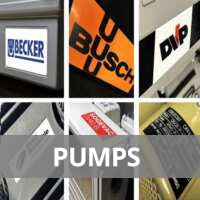
Whether your process demands a deep vacuum or high air flow, VacAir Superstore has the right pump for you. We stock pumps from world-renowned brands like DVP, Becker, Busch, and Elmo Rietschle, ensuring you get a reliable solution every time. Our expert team is ready to help you select the ideal vacuum pump for your specific needs.
VacAir Superstore holds extensive stocks of used and refurbished vacuum pumps. Call us with your requirement as our stock changes daily.
This article was written by VacAir’s Technical Sales Team


Trust VacAir Superstore for all your vacuum pump needs.
Contact us today to learn how we can help you save money and keep your operations running smoothly.
